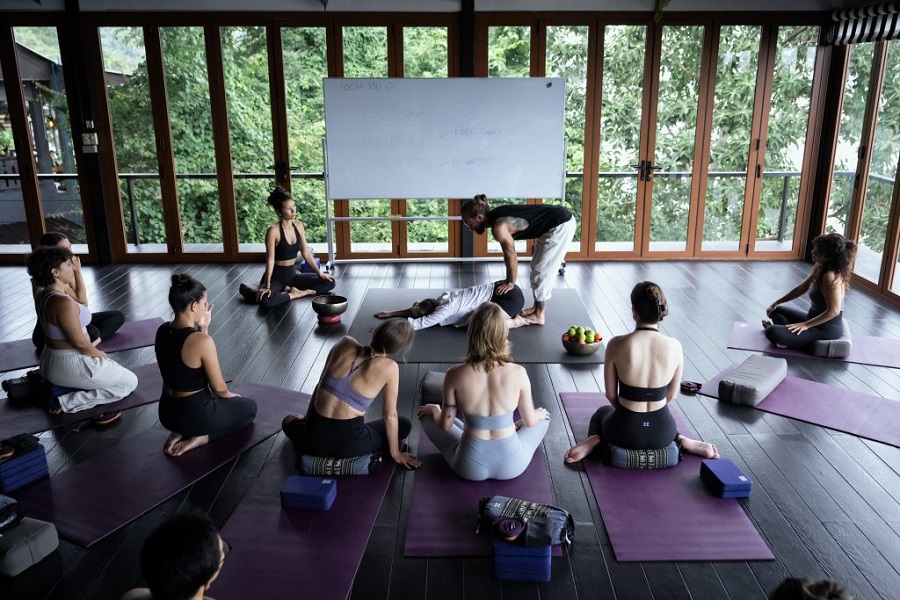
Group yoga can accommodate a wide range of participants through props, smaller ranges and alternative positions. However, there are situations in which occasional modifications do not provide enough time or individual attention. People considering private yoga classes singapore may benefit when their needs affect multiple parts of the class rather than one isolated pose.
Private instruction is not automatically better than group practice. Its value comes from creating time to assess movement, test options and build a repeatable plan before the participant returns to a wider class environment.
Group Classes Work Within Shared Constraints
A group instructor must guide the complete room. They can offer alternatives and respond to questions, but they cannot continuously redesign the sequence for one person.
This becomes challenging when a participant needs adjustments for most standing poses, floor transitions and arm-supported positions. Repeated uncertainty can interrupt both learning and confidence.
The issue is not that the group instructor has failed. The class format has a different purpose and a limited amount of individual teaching time.
A private session can investigate the recurring problem without requiring the rest of the group to wait.
One Modification May Create Another Problem
A common class modification might reduce discomfort in one area while changing demand elsewhere. Elevating the hands can reduce the depth of a fold, for example, but the participant may still need guidance on foot position or trunk control.
Similarly, replacing an arm-supported pose with a floor exercise may remove wrist loading while failing to address the broader objective of shoulder and trunk coordination.
Private instruction allows several options to be tested. The participant can compare how each variation feels and learn which one preserves the purpose of the movement.
This is more useful than memorising a generic alternative without understanding why it was chosen.
Recurring Pain Requires Appropriate Boundaries
Private yoga can adapt movement around known limitations, but it should not be treated as a substitute for medical assessment.
Persistent pain, sudden weakness, numbness, swelling or unexplained changes in movement require guidance from an appropriate healthcare professional. A yoga instructor should not diagnose the cause.
When the participant has received clinical advice, private yoga may help translate relevant recommendations into a practical class strategy. Communication between professionals can be valuable when the participant provides consent.
The session should remain within the instructor’s training and scope.
Private Sessions Can Rebuild Confidence
A participant may avoid group classes after an uncomfortable experience, a long break or a change in physical capacity. The main barrier may be uncertainty rather than inability.
A private setting gives the person time to ask questions and repeat transitions. The instructor can explain how to use props, when to rest and how to recognise an unsuitable range.
Confidence should be built through predictable success, not through reassurance alone. A movement needs to feel manageable and reversible before the participant is expected to perform it in a faster group sequence.
Transitions Often Need More Attention Than Poses
Group modifications commonly focus on the final posture. Yet getting down to the floor, changing sides and returning to standing may be the most difficult parts for some participants.
A private session can examine these transitions independently. The instructor may test the height of support, preferred leading leg or amount of hand assistance.
Useful transition goals include:
- Moving from standing to the floor without rushing.
- Changing sides without losing balance.
- Rising from a low position with appropriate support.
- Managing wrist load during floor transitions.
- Keeping breathing steady while changing orientation.
- Knowing how to leave a pose safely.
Once these tasks become familiar, group participation may feel substantially easier.
Individual Instruction Helps With Complex Schedules
Some Singapore professionals cannot attend the same group class every week because of travel, shift work or unpredictable meetings. Repeatedly entering unfamiliar classes can make progression difficult.
A private programme can focus on a consistent set of priorities despite irregular scheduling. Sessions may also include a short independent routine that can be used during travel or busy periods.
The advantage is not convenience alone. Continuity can be maintained even when attendance frequency changes.
Scheduling should still be realistic. Private access does not make recovery needs disappear.
A Bridge Back to Group Practice
Private yoga does not need to become a permanent replacement for group classes. It can serve as a temporary bridge.
A practical process might include:
- Identifying the movements that repeatedly create difficulty.
- Testing props and variations.
- Practising key transitions.
- Building a short home routine.
- Attending a suitable group class.
- Reviewing what worked and what remained difficult.
This cycle allows private instruction to support broader participation rather than creating dependency.
Some participants may prefer ongoing one-to-one training, which is also reasonable when it matches their goals and budget.
Know What to Expect From the Instructor
A private instructor should ask about goals, relevant health information, previous experience and current activity. They should explain the purpose of selected exercises and invite feedback.
Participants can expect the programme to change according to response. They should not expect guaranteed pain relief, medical treatment or immediate achievement of advanced poses.
The relationship works best when both parties agree on what will be reviewed and how progress will be recognised.
Decide According to the Pattern
At Yoga Edition, participants can use one-to-one sessions to explore recurring movement challenges in greater detail. The instructor can then develop options that the participant understands and can apply independently.
A single difficult pose does not always justify private instruction. Repeated uncertainty across several parts of class, substantial transition difficulties or a need for focused skill development creates a stronger case.
Group modifications are valuable, but they operate within a shared format. When those modifications become too frequent or too general, private yoga can provide the time needed to turn temporary adjustments into an organised movement strategy.